
Creating Illegal Immigrants
Re(Made) in India, Saved from Bangladesh and other twists and turns of NRC-CAA

Not long ago, Dipali Das was granted Indian citizenship under the Citizenship Amendment Act, 2019. The decision has been celebrated as a landmark victory. Media outlets, large and small, have reported on the success of the Act, presenting it as an example of how the law can help those fleeing persecution. The Act provides an accelerated pathway to Indian citizenship for undocumented non-Muslim minorities, such as Hindus, Sikhs, Buddhists, Jains, Parsis, and Christians from Afghanistan, Bangladesh, and Pakistan, who entered India on or before December 31, 2014. It reduces the naturalization residency requirement from eleven years to five. Notably, the law does not apply to Tamil refugees from Sri Lanka.
According to the current government, the CAA is especially crucial for states like Assam and West Bengal, where it has been promoted alongside the NRC as a complementary measure. The NRC aims to identifyundocumented foreigners who entered the country after March 24, 1971, the year marking Bangladesh’s independence from Pakistan. There is more to unpack regarding the Assam Accord, which established this cut-off date for proving nationality in a partitioned subcontinent, but I will not delve into that here.
I am interested in Dipali Das’s case specifically because, in 2021, while researching a book I was translating for this Substack, I came across an article by a social worker about her situation. The article used her case to illustrate the legal predicament faced by women like Sulekha Das, Minara Begum, and Shanara Begum: women who must prove their citizenship despite having identities legally tethered to their fathers or husbands, making it difficult to be tracked and recorded as legitimate citizens of India. The author also highlighted how many women in India never complete school-level education, thereby lacking another document that could have proven their presence in the only land they have ever known as home.
I translated that article at the time, conducted my own research, and spoke with several people handling her case. From these conversations, I understood the following facts:
She was born in India on December 3, 1966.
Her father, the late Suresh Chandra Das, appeared on the 1965 voter list for the Katigorah constituency.
She held a PAN card and a voter ID card.
What she lacked was a document proving she was indeed the daughter of the late Suresh Chandra Das.
No birth certificates were issued at the time of her birth.
She did not finish her schooling, so she had no School Leaving Certificate listing her as his daughter.
In 2019, she was declared a foreigner and placed in a detention center, namely Silchar Central Jail.
In May 2021, she was released on bail during the pandemic to reduce overcrowding in jails.

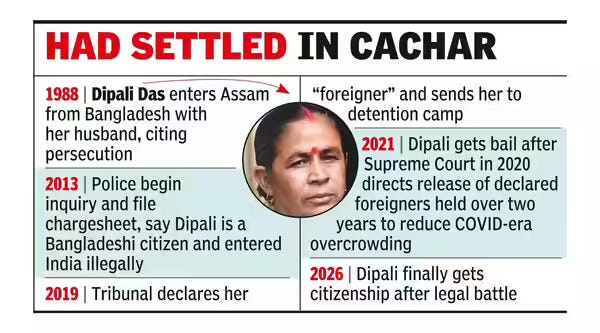
What unsettles me are the “current facts” that ultimately secured her citizenship. Many media outlets reported the success of her case. The Times of India, for instance, outlined a chronological narrative from which we learn a different set of facts:
Dipali Das was born in Bangladesh.
She entered India in 1988 to escape religious persecution, accompanied by her husband, who has since passed away, and began living in India.
In 2013, the police filed a chargesheet against her, questioning her citizenship status.
In 2019, she was declared a foreigner and sent to a detention centre (Silchar Central Jail).
This is where my facts, fictions, and imagination begin to cross wires, producing a story that simply does not make sense. If Suresh Chandra Das was a documented Indian citizen residing in India, how could his daughter have been born in Bangladesh? How could she have married a man there, only to flee religious persecution in 1988 and enter India undocumented? And why, after arriving, did civil society members spend years trying to prove that she was not a foreign national?
Documentation and evidence often fall flat when we try to prove or disprove citizenship. We have seen this across the globe, especially in the United States, where forged documents are routinely required to resist deportation and the criminalization of a person’s lawful presence. Dipali Das lived in India, married, raised children, and contributed to society in various ways and yet she still had to re-prove her existence to live freely. Hannah Arendt observed that when rational truth is opposed, it may be dismissed as a mistake or an error. But when factual truth is opposed, lying takes over. The state wields this lying as power, and it compels its subjects to participate, to change who they are, to rewrite their histories and identities to fit a world where factual truth has ceased to matter. In India, and particularly in Assam since the CAA-NRC, we have entered a reality where truth no longer functions. We are forced to fabricate our own truths and facts simply to survive. The documentation process for proving citizenship has become a space where, as Arendt warned, “lying becomes systematic, public, organized, and politically central.” This system did not emerge through discussion, consent, or democratic debate. It was driven by an imagined majority and a politics of fear designed to placate it. To prove I am a citizen of India, I must first be treated as a non-citizen. The process exists to validate the dominant narrative, not to adhere to facts. It resembles children play-acting Ghar-Ghar and Ranna-Bati, adopting adult power dynamics while mimicking their scripts.
Assam has been living in a state of “permanent emergency,” where truth must not merely be distorted into a plain lie, but replaced by an entirely new reality. Politicians lie; governments are built on lies. It is expected that the state or dominant power will deceive the rest to maintain control. But when a narrative is held long enough, the lies multiply, repeat, and eventually take on a life of their own. The propaganda that Government A is the saviour of Group B across States P, Q, and R requires a foundation of repeated falsehoods. These falsehoods seep into legal and social frameworks, hardening into policy and law. Now, those laws demand compliance: Person C, who has never set foot in P, Q, or R, must pretend to belong there so that Government A’s fantasy can manifest as “positive” reality, not as the cruelty of detention camps or the abandonment of a pregnant woman in a foreign forest, but as a narrative of rescue. The state claims it is saving persecuted women from oppressive regimes, while simultaneously “protecting” its own citizens from the supposed threat of foreigners who might one day displace them. Arendt noted that when a propaganda image is constructed, both the deceiver and the deceived collaborate to sustain it. This is precisely what occurs when Dipali Das is granted citizenship through the CAA.
Before dwelling on the gross injustices suffered by people like Dipali Das, I want to ask: why and how did the state create the category of “illegal immigrant” in the first place? Why has India become a deeply ethnonationalist society? To unite people across divisions of caste and class, the state manufactures an external enemy: “the Bangladeshi.” While the current government works to disenfranchise Muslims, the project succeeds because of widespread societal support for nativist sentiment. Across India, in nearly every state with even modest migration, there is a clear narrative: newcomers do not belong. They are taking resources, stealing jobs, straining the land. Without this quiet, cross-ideological cheer, from the left, the center, the liberals, the Marxists, and the right, the NRC and the legitimization of the CAA would not have been possible. We have criminalized migration, and the state has given that criminality a legal form. It deployed technology that failed, flooded the system with data, and now, to avoid accountability, demands our compliance. We are expected to keep play-acting so that the CAA appears benevolent, a lifeline for those persecuted by cartoonish foreign overlords in Pakistan and Bangladesh. But I believe the cruelty of the NRC and CAA would not thrive so powerfully without the deeply entrenched anti-migrant sentiment that runs through the very core of Indian society, from top to bottom, left to right.
Dipali Das has lived in India since 1988 or 1966. She has held some form of documentation, worked in various capacities, and most likely voted as a citizen for over twenty-five years, until suddenly she was declared illegal, sent to a detention camp, and then “saved” by the same government from the persecution she allegedly fled in 1988, even as her father had already voted in 1965 in India. I no longer know where fact ends and fabrication begins. The same writer who defended her in 2021, insisting she was never an illegal migrant, is also the self-proclaimed social worker who publicly praised the CAA for “saving” her. I cannot tell where rescue ends and incarceration begins. For Bengalis whose names are being scrubbed from electoral rolls today, this may appear to be a separate crisis, born of a different context. Yet the underlying reality remains unchanged: who belongs, where, and when is ultimately a matter of chance, circumstance, and political convenience. Around seventy people have died by suicide after their names disappeared from the SIR. Forty Booth Level Officers (BLOs) took their own lives while implementing the revision. In June 2019 alone, at least fifty-one deaths were linked to the panic and exhaustion of the NRC process. If only they had known: if the state can declare you a foreigner, it can also “save” you provided, of course, you are not Muslim.
The boundary between fact and fantasy, propaganda and reality, has grown porous, much like the borders we are taught to fear. But this blurring costs lives. And yet, in the era we inhabit, death has become so routine that it no longer shocks or grieves us. I repost. I reshare. Most of the time, I scroll past, my mind numbed to the accumulation of bodies. I may have stopped thinking altogether, as so many of us already have. Many simply accept the lie, because play-acting has always been easier. And if pretending can save lives, then truth begins to feel like a hindrance.